
This education pack accompanies the newly published ‘The Street is Not a Home’, a children’s book co-produced with children at LEEDO Pace Home. You can support the Crowdfunder at:
https://www.crowdfunder.co.uk/p/thestreetisnotahome
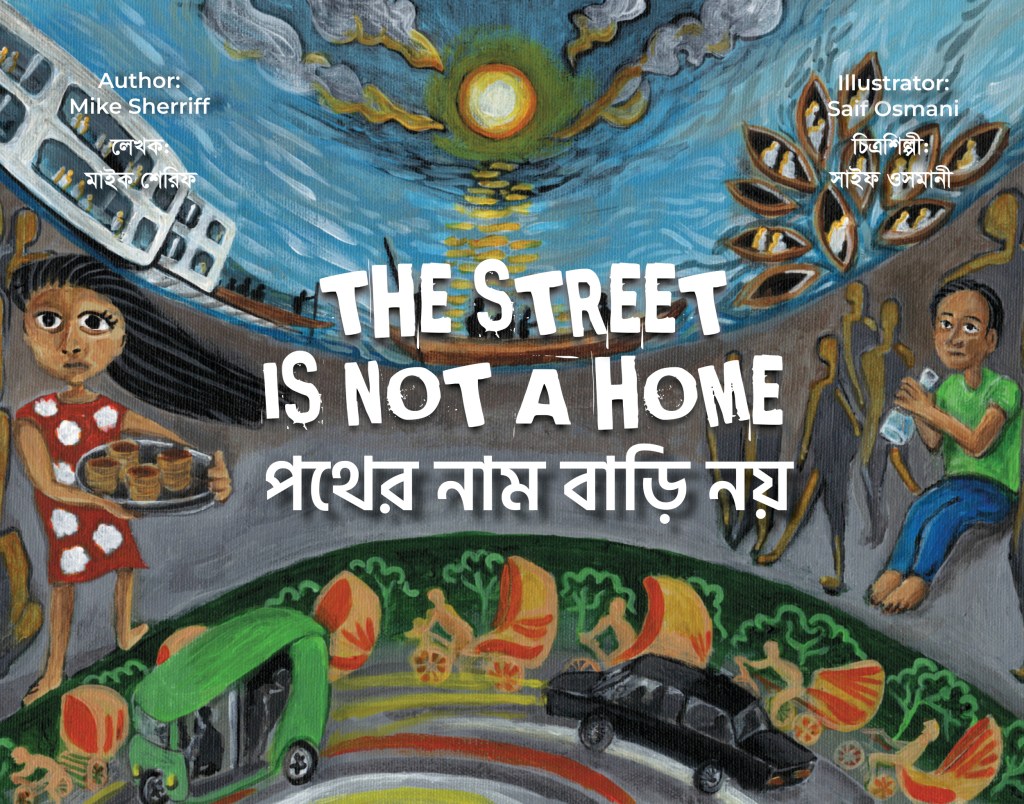
Some of the following topics may be discussed with children who are reading the stories in the book “The Street is Not a Home”:
Discussion about Bangladesh
• The rivers of Bangladesh, how they form a delta, how they are becoming polluted and the effects of pollution.
• Discuss the fruits and vegetables that can be found in each season in Bangladesh including the national fruit – Jackfruit.
• Flowers found in Bangladesh including the national flower- water lily.
• Fish found in Bangladesh including the national fish of Bangladesh – Hilsa.
• Games played by children in Bangladesh (and other countries) including carrom and marbles.
• Fairs in Bangladesh and what can be found there.
• The places in Bangladesh mentioned in the story – Dhaka, Mymensingh, Sunamganj, Sylhet, Barisal, Bhola, Chittagong, Cox’s Bazar.
• Discuss journeys using the different types of transport mentioned in the stories – ferries of different sizes, rickshaw, leguna, train, and bus.
• The Sufi Saint Shahjalal and his shrine in Sylhet.
• Music, musical instruments, and songs in Bangladesh including how they are shared by people from different religious backgrounds.
• Artists in Bangladesh and their work including the famine pictures of the famous painter Zainul Abedin.
• The Bengal famine that occurred during the Second World War and its causes.
• The 1971 war for independence of Bangladesh from Pakistan.
• Economic development in Bangladesh since 1971 and movement of people from rural areas to cities (especially the capital city, Dhaka).
Discussion about children and the circumstances in which they live
• The circumstances in which children are born, and how this affects what they can grow up to become. The difference between growing up as part of a well- off family and a family living in poverty.
• How different places provide different opportunities for children growing up e.g. the difference between living in a city and a village.
• The similarities and differences between the experiences of boys and girls in the stories.
• The foods mentioned in the stories, and how healthy or unhealthy they are to eat.
• The impact on children of families breaking down and how children should be treated when this happens.
• The different ways in which adults and children can be cruel and unkind to vulnerable children (including sexual harassment) and what can be done about this.
• How it feels for children to be left out of something other children are doing such as going to the museum, park, or zoo.
• Children being forced to beg or work.
• Children not being allowed to go to school by their parents or those looking after them.
• Children and families sleeping on the streets.
• Children and families not having enough money.
• The risks and dangers of smoking cigarettes and taking other types of drug. In what circumstances might children start to use these?
Children’s future and how to help children have a better future
• The role of education, teachers, parents, and others in helping children to take advantage of opportunities that will give them a better future.
• What makes a school enjoyable and why might children not enjoy going to school.
• After school activities and their importance to children.
• Why children staying at a shelter should be registered with the police.
• Examples of generosity in the story – children being given fruit and fish.
• The potential of all children to contribute to the society where they live.
Some other points
• Jobs where people do not earn much money such as -cleaning, cooking, labourer, driver, assistant on a bus – what can be done about this?
• Borders between countries and how these are marked and guarded.
Click here to DOWNLOAD a pdf copy of the above content in English and Bengali:
Alternatively click on this link: https://streetchildrenbd.uk/wp-content/uploads/2023/01/education-pack-1.1.2023.pdf
 Friends of Street Children Bangladesh